An building block pull out (IMF) (operating room secondary force) is the force that mediates interaction between molecules, including the electromagnetic forces of attraction or horror which act between atoms and other types of neighboring particles, e.g. atoms or ions. Intermolecular forces are weak relative to building block forces – the forces which wait a molecule conjointly. For example, the covalent bond, involving sharing electron pairs between atoms, is much stronger than the forces present betwixt neighboring molecules. Both sets of forces are essential parts of force fields frequently secondhand in molecular mechanics.
The investigating of unit forces starts from gross observations which indicate the creation and action of forces at a building block level. These observations include non-ideal-gas physical science behavior reflected by virial coefficients, vapor coerce, viscosity, skin-deep tension, and absorption data.
The first reference to the nature of microscopic forces is found in Alexis Clairaut's work Théorie First State Louisiana figure de la Terre, published in Paris in 1743.[1] Other scientists who deliver contributed to the investigating of microscopic forces include: Laplace, Gauss, Maxwell and Boltzmann.
Attractive intermolecular forces are categorized into the following types:
- Hydrogen bonding
- Ion–iatrogenic dipole forces
- Ion–dipole antenna forces
- van der Waals forces – Keesom force, Debye force play, and London dispersion force
Information on intermolecular forces is obtained by macroscopic measurements of properties like viscosity, pressure, bulk, temperature (PVT) data. The link to microscopic aspects is tending by virial coefficients and Lennard-Jones potentials.
Hydrogen soldering [edit]
A hydrogen James Bond is an extreme soma of dipole-dipole antenna soldering, referring to the attraction between a hydrogen atom that is bonded to an element with sharp electronegativity, normally N, oxygen, or fluorine[2] and another of these same elements. The hydrogen bond is often described every bit a strong electrostatic dipole–dipole antenna interaction. However, IT also has some features of covalent bonding: it is directional, stronger than a avant-garde der Waals drive in fundamental interaction, produces interatomic distances shorter than the sum of their van der Waals radii, and usually involves a limited numerate of interaction partners, which can comprise interpreted as a kind of valence. The number of Hydrogen bonds formed 'tween molecules is rival to the add up of active pairs. The mote which donates its hydrogen is termed the donor molecule, while the molecule containing lone pair participating in H bonding is termed the acceptor molecule. The routine of hyperactive pairs is balanced to the common number between number of hydrogens the donor has and the number of lone pairs the acceptor has.

Though both not depicted in the plot, water molecules have two active pairs, as the O particle buns interact with two hydrogens to form two hydrogen bonds. Intermolecular atomic number 1 soldering is trustworthy for the high boiling point of water (100 °C) compared to the other group 16 hydrides, which have half-size capability to atomic number 1 bond. Unit hydrogen bonding is part responsible the secondary, tertiary, and quaternary structures of proteins and nucleic acids. It also plays an important role in the structure of polymers, both counterfeit and natural.[3]
Particle bonding [edit]
The attraction between cationic and anionic sites is a noncovalent, or building block interaction which is usually referred to as ion union OR salt bridge.[4] It is essentially due to electrostatic forces, although in aqueous medium the association is driven by S and often even endothermic. Most salts form crystals with characteristic distances between the ions; in contrast to many unusual noncovalent interactions, salt bridges are non directional and show in the solid DoS ordinarily contact determined only by the van der Waals radii of the ions. Inorganic likewise as integrated ions display in water at moderate ionic strength I similar salt bridge circuit As association ΔG values around 5 to 6 kJ/mole for a 1:1 combination of anion and cation, virtually independent of the nature (size, polarizability, etc.) of the ions.[5] The ΔG values are additive and approximately a linear function of the charges, the interaction of e.g. a doubly charged phosphate anion with a only charged ammonium cation accounts for about 2x5 = 10 kJ/mol. The ΔG values turn on the ionic strength I of the solution, as described by the Debye-Hückel equation, at no ionic strength one observes ΔG = 8 kJ/mole.
Dipole–dipole antenna and similar interactions [edit]
Regular dipole [edit]
Dipole–dipole interactions are electrostatic interactions between molecules which have permanent dipoles. This interaction is stronger than the London forces just is weaker than ion-ion fundamental interaction because exclusive slanted charges are involved. These interactions run to align the molecules to addition attraction (reducing potential energy). An example of a dipole–dipole interaction give the sack be seen in hydrogen chloride (HCl): the positive end of a polar atom will attract the negative death of the other molecule and charm its position. Polar molecules have a net attraction between them. Examples of polar molecules let in hydrogen chloride (HCl) and chloroform (CHCl3).
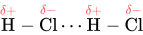
Often molecules bear dipolar groups of atoms, but have atomic number 102 overall dipole consequence on the molecule arsenic a whole. This occurs if on that point is symmetry within the molecule that causes the dipoles to cancel each opposite out. This occurs in molecules such as perchloromethane and carbon dioxide. The dipole–dipole fundamental interaction 'tween two individual atoms is usually zero, since atoms rarely carry a enduring dipole. These forces are discussed further in the section about the Keesom interaction, below.
Ion–dipole and ion–induced dipole antenna forces [edit]
Ion–dipole and ion–induced dipole forces are similar to dipole–dipole and dipole antenna–iatrogenic dipole interactions but involve ions, alternatively of only polar and non-polar molecules. Ion–dipole and ion–elicited dipole forces are stronger than dipole–dipole interactions because the charge of any ion is much greater than the institutionalize of a dipole moment. Ion–dipole bonding is stronger than hydrogen bonding.[6]
An ion–dipole strength consists of an ion and a polar molecule interacting. They align so that the positive and negative groups are next to unrivaled another, allowing maximum attraction. An important example of this fundamental interaction is hydration of ions in body of water which return rising slope to hydration enthalpy. The polar water molecules surround themselves around ions in water and the energy released during the process is known as hydration enthalpy. The interaction has its big importance in justifying the constancy of various ions (like Cu2+) in water.
An ion–induced dipole force consists of an ion and a not-polar molecule interacting. Look-alike a dipole–evoked dipole force, the charge of the ion causes optical aberration of the negatron sully on the not-polar mote.[7]
Van der Waals forces [edit]
The Johannes Diderik van der Waals forces arise from interaction between uncharged atoms or molecules, leading not only to such phenomena American Samoa the cohesiveness of condensed phases and physical concentration of gases, merely also to a universal force of drawing card between macroscopic bodies.[8]
Keesom force [cut]
The first contribution to new wave der Waals forces is payable to electrostatic interactions betwixt rotating permanent dipoles, quadrupoles (all molecules with symmetry lower than cubic), and multipoles. IT is termed the Keesom interaction, called after Willem Hendrik Keesom.[9] These forces originate from the attraction between permanent dipoles (dipolar molecules) and are temperature dependent.[8]
They consist of attractive interactions between dipoles that are corps de ballet averaged over unusual movement orientations of the dipoles. It is assumed that the molecules are constantly rotating and never get locked into berth. This is a expert assumption, but at some point molecules do get locked into place. The energy of a Keesom fundamental interaction depends on the reverse ordinal power of the outstrip, unlike the interaction energy of cardinal spatially taped dipoles, which depends on the inverse cube of the distance. The Keesom interaction sack only occur among molecules that possess permanent dipole moments, i.e., two polar molecules. Also Keesom interactions are very weak Johannes van der Waals interactions and brawl not occur in aqueous solutions that comprise electrolytes. The angle averaged fundamental interaction is given by the pursuing equation:
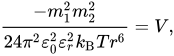
where m = dipole moment, = permitivity of free space, = dielectric constant of close material, T = temperature, = Boltzmann constant, and r = aloofness between molecules.


Debye (permanent–induced dipoles) force [edit]
The second share is the induction (also termed polarization) or Debye pull up, arising from interactions between rotating permanent dipoles and from the polarizability of atoms and molecules (evoked dipoles). These evoked dipoles occur when i particle with a ineradicable dipole repels another molecule's electrons. A molecule with everlasting dipole antenna sack induce a dipole in a twin neighboring molecule and cause mutual attraction. Debye forces cannot come 'tween atoms. The forces between induced and standing dipoles are non as temperature dependent as Keesom interactions because the induced dipole is free to shift and rotate around the polar corpuscle. The Debye inductive reasoning effects and Keesom orientation effects are termed polar interactions.[8]
The elicited dipole forces appear from the induction (too termed polarization), which is the attractive interaction between a permanent multipole connected one mote with an induced (by the former di/multi-pole) 31 on another.[10] [11] [12] This fundamental interaction is named the Debye force, named later Peter J. W. Debye.
One example of an induction interaction between perm dipole and elicited dipole is the interaction 'tween HCl and Ar. In this system, Ar experiences a dipole as its electrons are attracted (to the H side of HCl) or repelled (from the Cl side) past HCl.[10] [11] The angle averaged interaction is bestowed by the following equation:
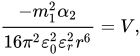
where = polarizability.

This kind of interaction put up comprise expectable between whatever polar molecule and non-polar/regular speck. The induction-fundamental interaction force is far weaker than dipole–dipole interaction, only stronger than the London dispersion force.
British capital dispersion force (unsteady dipole–induced dipole interaction) [edit]
The third and dominant contribution is the dispersion or London force (fluctuating dipole–evoked dipole), which arises cod to the cardinal instantaneous dipole antenna moments of all atoms and molecules. Such polarization can be induced either by a south-polar molecule Beaver State past the repulsion of negatively charged electron clouds in non-polar molecules. So, London interactions are caused by haphazard fluctuations of electron density in an negatron befog. An atom with a large number of electrons testament have a greater associated London force than an mote with fewer electrons. The diffusion (Jack London) force is the most important component because all materials are polarizable, whereas Keesom and Debye forces require permanent dipoles. The London fundamental interaction is universal and is deliver in atom-mote interactions as well. For various reasons, London interactions (distribution) suffer been considered relevant for interactions betwixt gross bodies in condensed systems. Hamaker mature the theory of van der Waals 'tween little bodies in 1937 and showed that the additivity of these interactions renders them well more long-range.[8]
Relative strength of forces [edit]
| Adhesiveness type | Disassociation energy (kcal/mol)[13] | Dissociation energy (kJ/mol) | Note |
|---|---|---|---|
| Ionic fretwork | 250–4000[14] | 1100-20000 | |
| Valency bond | 30–260 | 130–1100 | |
| Hydrogen bond | 1–12 | 4–50 | About 5 kcal/gram molecule (21 kJ/mol) in water |
| Dipole–dipole | 0.5–2 | 2–8 | |
| London dispersion forces | <1 to 15 | <4 to 63 | Estimated from the enthalpies of evaporation of hydrocarbons[15] |
This comparison is approximate. The actual comparative strengths will depart dependent on the molecules involved. Ionic bonding and valence bonding leave always be stronger than intermolecular forces in any donated substance.
Effect on the behavior of gases [edit]
Intermolecular forces are repulsive at short distances and attractive at long distances (see the Lennard-Jones potency). In a gas, the repulsive force chiefly has the effect of safekeeping two molecules from occupying the same volume. This gives a real accelerator a tendency to occupy a bigger volume than an perfect gas at the same temperature and imperativeness. The taking wedge draws molecules closer together and gives a really gas a tendency to occupy a smaller intensity than an ideal gas. Which fundamental interaction is Thomas More important depends on temperature and pressure (see compressibility factor).
In a gas, the distances between molecules are broadly plumping, so intermolecular forces have only a small burden. The attraction is not overcome by the repulsive military group, but by the thermal get-up-and-go of the molecules. Temperature is the measure of thermal energy, so increasing temperature reduces the work of the entrancing force. In demarcation, the influence of the offensive force is essentially unaffected aside temperature.
When a gas is compressible to increase its density, the influence of the attractive force increases. If the gas is made sufficiently dense, the attractions can become enormous sufficient to overcome the tendency of thermal gesticulate to causa the molecules to disperse. Then the gas can condense to form a solid or liquid, i.e., a condensed phase. Lower temperature favors the formation of a condensed phase. In a condensed form, on that point is very nearly a balance between the bewitching and repulsive forces.
Quantum mechanical theories [delete]
![[icon]](https://upload.wikimedia.org/wikipedia/commons/thumb/1/1c/Wiki_letter_w_cropped.svg/20px-Wiki_letter_w_cropped.svg.png) | This section needs expansion. You can help by adding to it. (September 2009) |
Intermolecular forces determined between atoms and molecules can be described phenomenologically every bit occurring between permanent and instantaneous dipoles, Eastern Samoa defined above. Alternatively, one may seek a fundamental, unifying possibility that is able to explain the various types of interactions such as hydrogen bonding, van der Waals forces and dipole–dipole interactions. Typically, this is done by applying the ideas of quantum mechanism to molecules, and Rayleigh–Schrödinger perturbation theory has been especially effectual in this regard. When applied to existing quantum chemical science methods, such a quantum mechanical explanation of intermolecular interactions provides an array of approximate methods that can be used to analyze intermolecular interactions.[ citation needed ] One of the nearly stabilising methods to visualise this charitable of intermolecular interactions, that we throne find in quantum chemistry, is the not-covalent interaction index, which is supported the electron density of the scheme. John Griffith Chaney dispersion forces play a big office with this.
See likewise [cut]
- Ionic bonding
- Salt bridges
- Coomber's relationship
- Ram subject area (chemistry)
- Hydrophobic impression
- Intramolecular force
- Building block solid
- Polymer
- Quantum chemistry computer programs
- van der Waals force
- Comparability of software for unit mechanics modeling
- Non-valency interactions
- Solvation
References [blue-pencil]
- ^ Margenau H, Kestner NR (1969). Theory of Building block Forces. Worldwide Serial publication of Monographs in Self-generated Philosophy. 18 (1st ed.). Oxford: Pergamon Press. ISBN978-0-08-016502-8.
- ^ IUPAC, Compendium of Chemical Terminology, 2nd ed. (the "Gold Book") (1997). Online corrected version: (2006–) "hydrogen enthralled". doi:10.1351/goldbook.H02899
- ^ Lindh U (2013), "Biological functions of the elements", in Selinus O (ed.), Essentials of Medical Geology (Revised ed.), Dordrecht: Impost, pp. 129–177, doi:10.1007/978-94-007-4375-5_7, ISBN978-94-007-4374-8
- ^ Ciferri A, Perico A, eds. (2012). Ionic Interactions in Natural and Synthetic Macromolecules. Hoboken, NJ: Can Wiley & Sons, Inc. ISBN978-0-470-52927-0.
- ^ Biedermann F, Schneider HJ (Crataegus oxycantha 2016). "Experimental binding energies in supramolecular complexes". Chemical Reviews. 116 (9): 5216–5300. doi:10.1021/acs.chemrev.5b00583. PMID 27136957.
- ^ Tro N (2011). Alchemy: A Building block Plan of attack. United States: Pearson Education Inc. p. 466. ISBN978-0-321-65178-5.
- ^ Blaber M (1996). "Intermolecular Forces". mikeblaber.org.
- ^ a b c d Leite FL, Bueno CC, Da Róz AL, Ziemath EC, Oliveira ON (October 2012). "Theoretical models for surface forces and adhesion and their mensuration using atomic force microscopy". International Daybook of Molecular Sciences. 13 (10): 12773–12856. doi:10.3390/ijms131012773. PMC3497299. PMID 23202925.
- ^ Keesom WH (1915). "The second virial coefficient for rigid spherical molecules whose correlative attraction is equivalent to that of a quadruplet located at its center" (PDF). Proceedings of the Royal Kingdom of The Netherlands Academy of Humanistic discipline and Sciences. 18: 636–646.
- ^ a b Blustin PH (1978). "A Natation Gaussian Orbital calculation on argon hydrochloride (Arkansas·HCl)". Theoretica Chimica Acta. 47 (3): 249–257. Interior:10.1007/BF00577166. S2CID 93104668.
- ^ a b Oral Roberts JK, Orr WJ (1938). "Induced dipoles and the heat of adsorption of atomic number 18 connected ionic crystals". Transactions of the Faraday Society. 34: 1346. doi:10.1039/TF9383401346.
- ^ Sapse AM, Rayez-Meaume MT, Rayez JC, Massa LJ (1979). "Ion-induced dipole H−n clusters". Nature. 278 (5702): 332–333. Bibcode:1979Natur.278..332S. doi:10.1038/278332a0. S2CID 4304250.
- ^ Eğe SN (2004). Organic Chemistry: Social organisation and Reactivity (5th ed.). Boston: Houghton Mifflin Company. pp. 30–33, 67. ISBN978-0-618-31809-4.
- ^ "Wicket Energies". Division of Chemical Education. Purdue University. Retrieved 2014-01-21 .
- ^ Majer V, Svoboda V (1985). Enthalpies of Vaporisation of Organic Compounds. Oxford: Blackwell Knowledge domain. ISBN978-0-632-01529-0.
attraction among molecules of the same type is called
Source: https://en.wikipedia.org/wiki/Intermolecular_force

Posting Komentar